Zero Tariffs, EU Inventory: Why Indian E-commerce Sellers Can Win in Europe with the FTA
The India–EU Free Trade Agreement is expected to remove duties on most products Indian sellers export to Europe. Combined with the EU's new duty on low-value parcels, it makes holding stock inside the EU the stronger model.
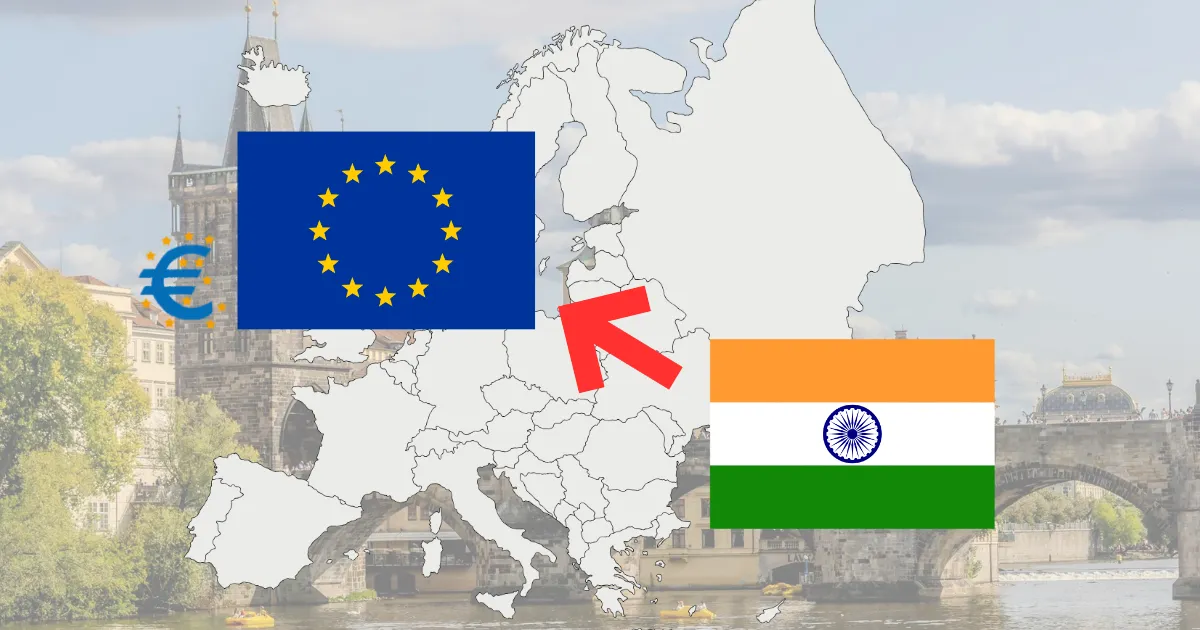
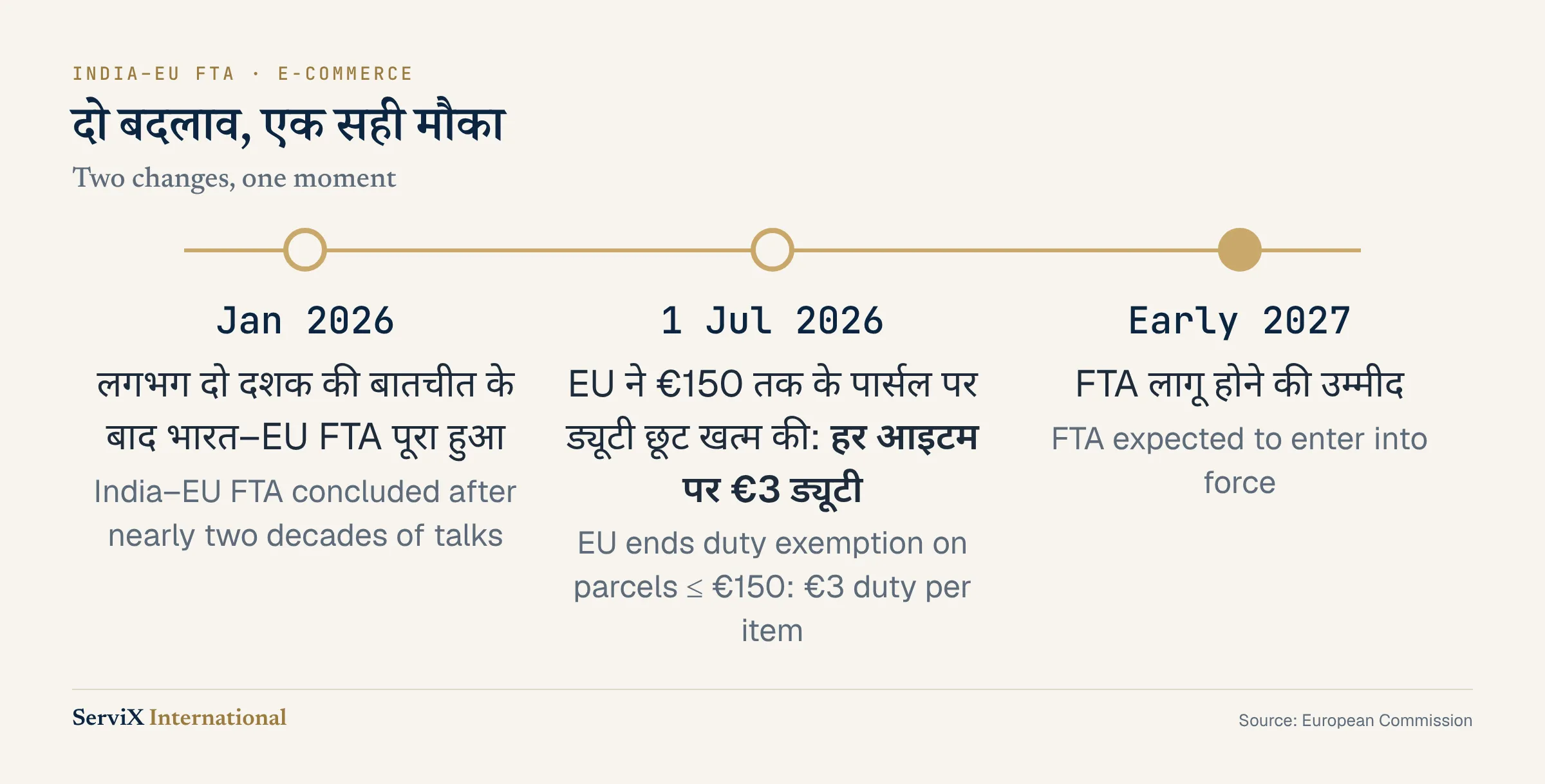
After nearly two decades of negotiations, India and the European Union concluded their Free Trade Agreement (FTA) in January 2026. The agreement is expected to be signed by the end of 2026 and to enter into force in early 2027. At the same time, the EU has started charging customs duty on low-value parcels that were previously duty-free.
Together, these two changes make this a good moment for Indian e-commerce sellers to rethink how they sell to Europe. This article explains the advantages the FTA brings to online sellers, the new parcel rules, and what you need to do to take advantage of both.
A turning point for Indian e-commerce sellers
The FTA is still in the approval process: it has to be signed, approved by the European Parliament and the Council, and ratified in India before it applies. Once it is in force, the trade rules change in a way that matters for online sellers.
At the same time, the EU is changing how customs duties apply to low-value parcels. Sellers who ship single orders from India to European customers will feel that change first.
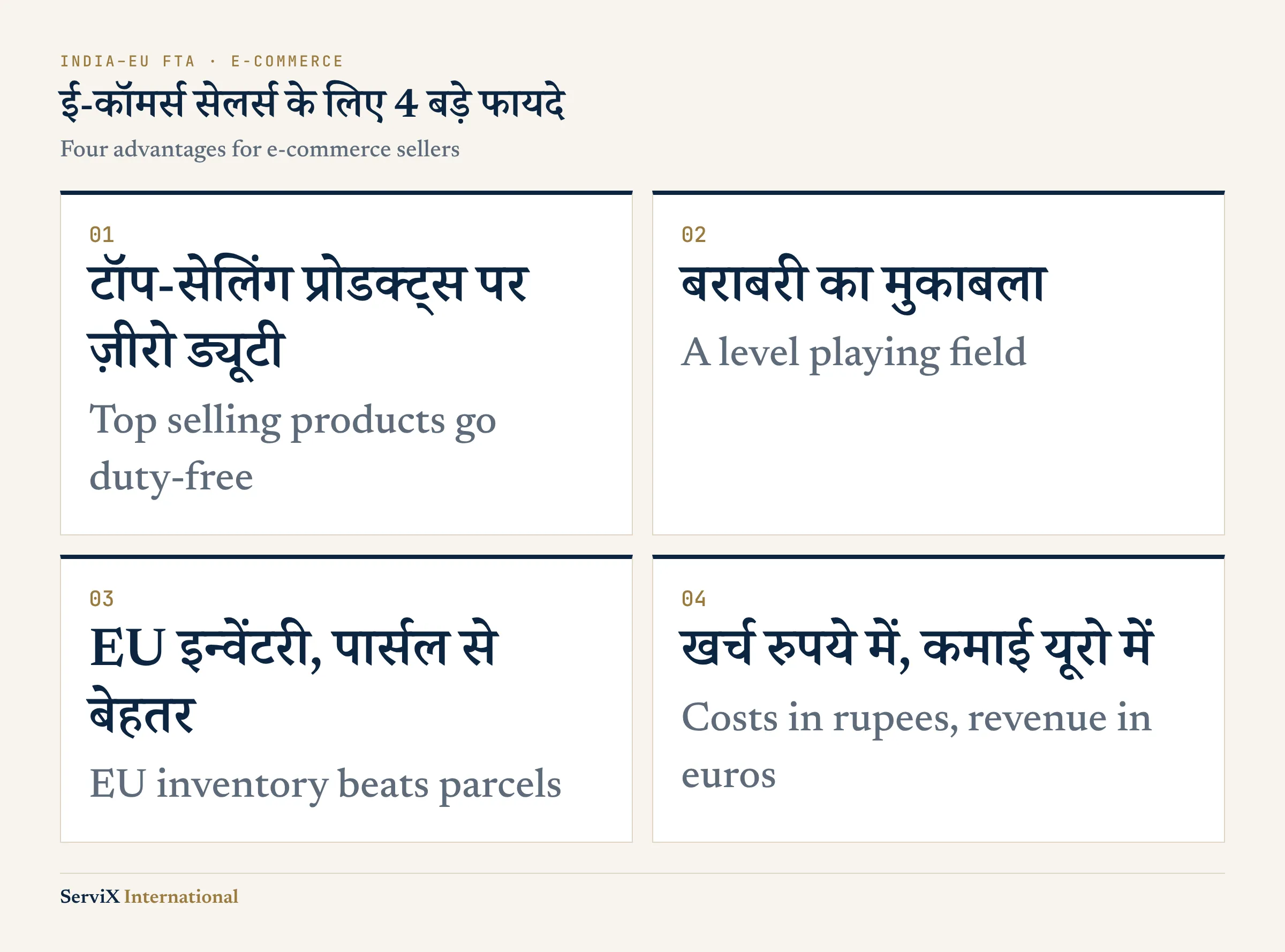
Advantage 1: top-selling e-commerce products go duty-free
Once the FTA enters into force, customs duties will be eliminated immediately on most Indian exports to the EU. The list includes many of the categories that sell best online:
- Apparel and home textiles
- Leather goods and footwear
- Jewellery
- Handicrafts and home décor
- Tea, coffee and spices
- Sports goods and toys
Today, apparel faces EU duties of up to 12%. Without that duty, sellers can lower their prices to become more competitive, or keep their prices and increase their margins.
Advantage 2: a level playing field with your competitors

Indian sellers have long been at a disadvantage in the EU. Competitors from Bangladesh, Vietnam and Turkey already export to Europe with preferential or zero-duty access.
The FTA closes this gap in one step. On marketplaces such as Amazon, Indian products will sit alongside competitors on equal price terms, and sellers can compete on quality, design and brand.
Advantage 3: the gap widens between parcel shippers and EU-stocked sellers
This is the most important point for e-commerce sellers.
Since 1 July 2026, the EU has abolished the customs duty exemption for imported parcels worth €150 or less. A temporary customs duty of €3 per item now applies instead (European Commission). This measure applies until 1 July 2028, after which normal customs duties will apply depending on the type of product. A separate per-parcel handling fee is also expected from November 2026.

In other words, shipping items one by one from India to end customers will become more expensive over time.
By contrast, sellers who import goods in bulk to a warehouse inside the EU (such as Amazon FBA) and sell from there will, once the FTA is in force, benefit fully from zero tariffs on many products.
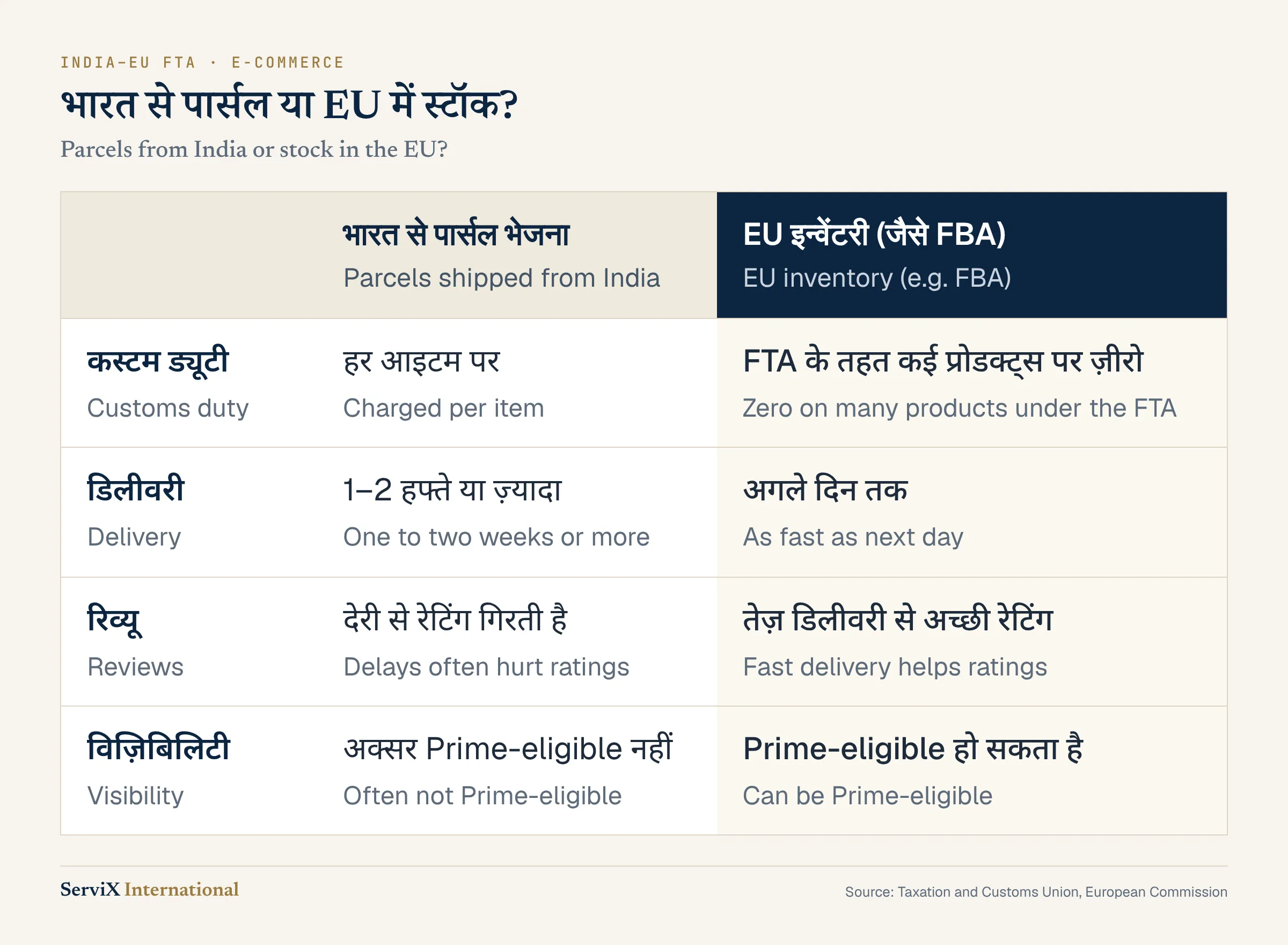
Faster delivery means better reviews and higher conversion rates. The FTA is a strong tailwind for sellers who move to an EU inventory model.
Advantage 4: costs in rupees, revenue in euros
Manufacture in India, sell in euros. This combination is a major strength for e-commerce sellers. By keeping production costs low while selling to European consumers with strong purchasing power, sellers can secure healthy margins.
A revenue stream that does not depend on the Indian domestic market alone also makes your business more resilient. With around 450 million consumers, the EU is one of the largest markets in the world.
What you need to unlock these advantages

To benefit from the FTA and sell in the EU, you need to prepare the following:
- Proof of origin. To apply the FTA’s zero tariffs, you need documents proving that your products originate in India.
- VAT registration. If you store and sell inventory inside the EU, you must register for VAT in each country where your stock is held. You do not need to set up a company in the EU. Once registered for VAT, you can sell under your Indian company.
- Packaging EPR (Extended Producer Responsibility) registration. Each country where you sell requires registration with its EPR scheme for your product packaging.
The catch: one EU market, 27 different tax rulebooks
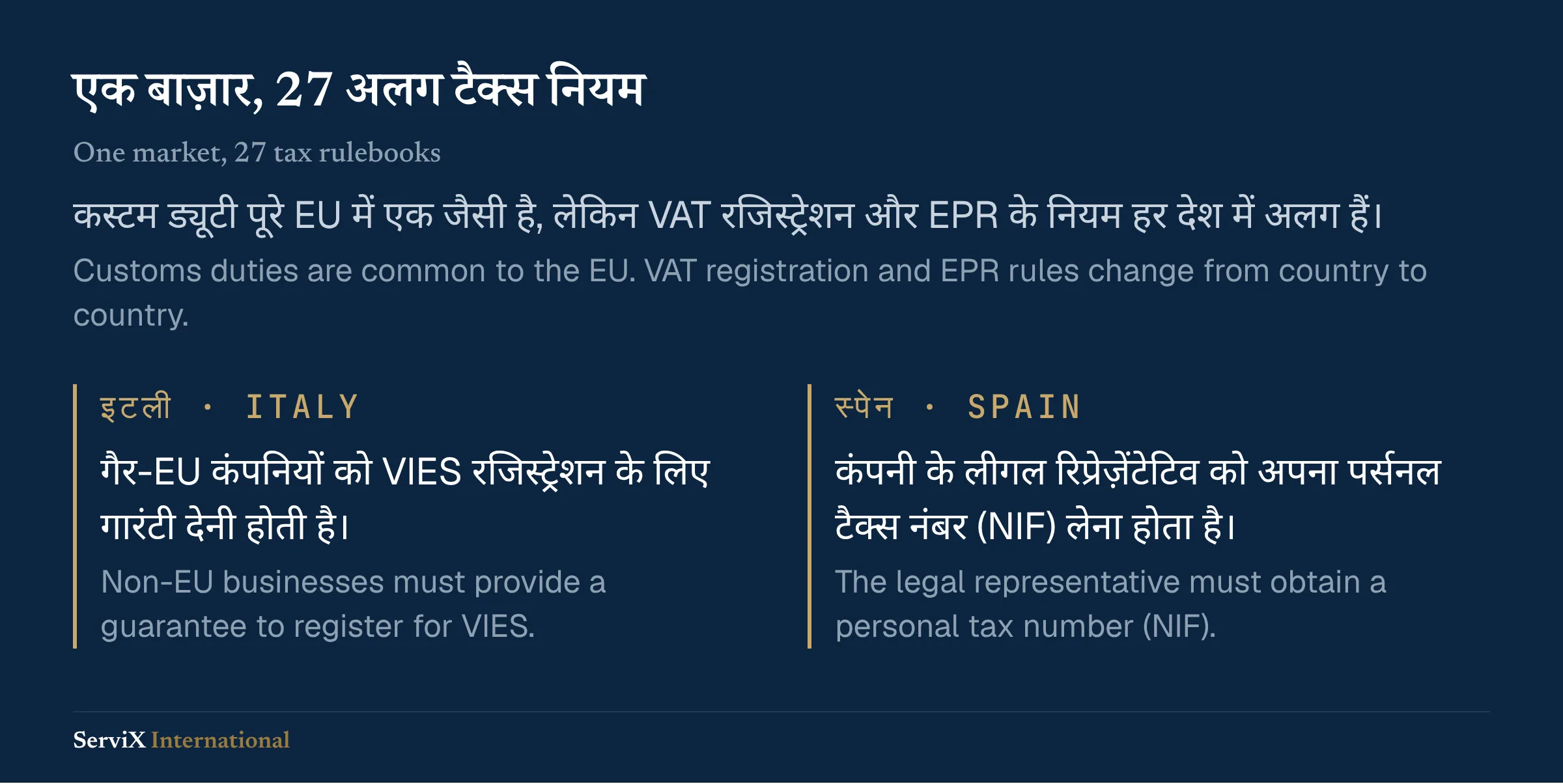
This is where many sellers stumble. Customs duties are the same across the EU, but VAT registration requirements and procedures differ greatly from country to country.
For example:
- In Italy, non-EU businesses must provide a guarantee to register for VIES, the system for VAT numbers used in intra-EU trade.
- In Spain, the company’s legal representative must obtain a personal tax identification number (NIF).
EPR works the same way: each country, such as Italy with CONAI, has its own scheme and registration process.
A procedure you researched for one country may not work at all in the next. If you want to sell in several countries, you have to research each set of rules from scratch, which costs time and adds risk. Mistakes can lead to registration delays or even suspended sales.
The solution: find a partner who knows local tax rules
Finding a partner with in-depth knowledge of each EU country’s tax rules is the key to a successful expansion. When choosing a partner, check the following:
- Do they cover multiple EU countries? You should not have to find a new provider every time you add a market.
- Do they hold local accounting and tax qualifications?
- Do they tell you about country-specific requirements in advance? A guarantee or a representative’s tax number can stop the process if you discover it too late.
- Can you talk to them in your own language?

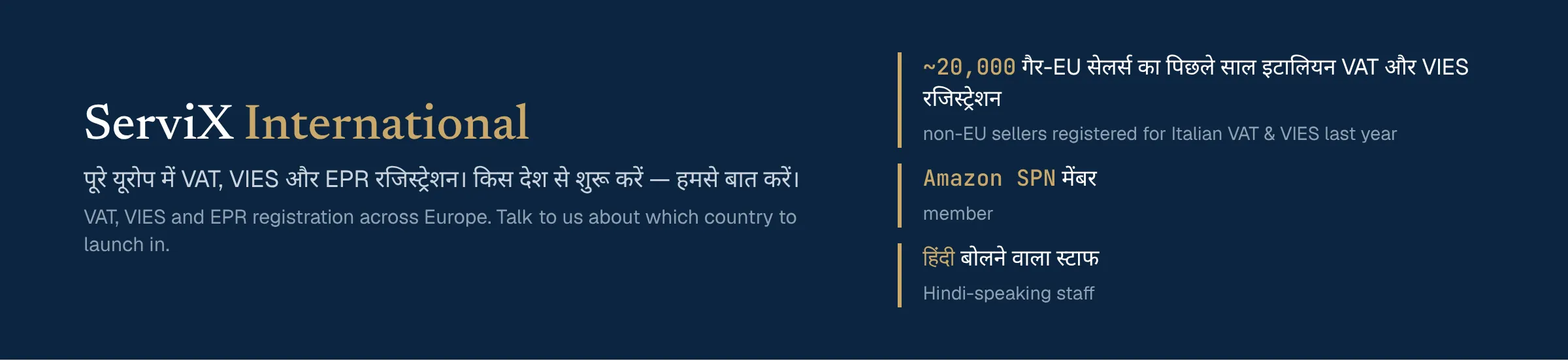
ServiX International supports VAT, VIES and EPR registration across Europe. Our team of qualified European chartered accountants maps out each country’s requirements in advance and handles the whole process with you.
- Italian VAT and VIES registration for around 20,000 non-EU sellers last year
- Member of the Amazon Service Provider Network (SPN)
- A surety insurance option to cover the Italian VIES guarantee
- Hindi-speaking staff on our team
Your roadmap to selling from day one of the FTA
- Now: decide which products to sell, and in which countries you will store and sell them.
- Three to six months before entry into force: complete VAT and EPR registration in each country with your partner. Timelines vary by country; Italian VAT registration, for example, takes four to six weeks. Start early to leave yourself room.
- On entry into force: move your stock to an EU warehouse and start selling.
The first sellers to benefit from the FTA will be those who are ready on the day it enters into force.
Ready to start? Talk to us about which country to launch in
Which country should you store your stock in? Are your products covered by the FTA? What do you need for VAT registration? The ServiX International specialists are here to answer your questions about expanding into the EU.
Sources
Planning your entry into the Italian market?
Tell us about your business and our team will map the VAT, VIES and guarantee steps for your case — usually within one business day.